Sandbach Tinne Collection
I suspect, that in ten years’ time, we’ll look back at the study of slavery and try to remember what it was like before we’d heard of the Sandbach Tinne dynasty. We’ll struggle to imagine how we tried to understand Britain’s involvement in slavery and the slave trade without this huge dynastic epic at the centre of it. " Professor David Olusoga OBE
The Sandbach Tinne Collection comprises business and personal letters, accounts, invoices, shipping and insurance documents, portraits, etc., from the business partners, family and business associates of the firm Sandbach Tinne & Co. (operating from 1814 to 1975) their subsidiaries and precursor mercantile entities, including McInroy Parker & Co., Glasgow (founded 1794), McInroy Sandbach & Co., Demerara (founded 1790, later renamed Sandbach Parker & Co.), McInroy Sandbach & McBean, Demerara (1803), Robertson Parker & Co., Grenada (founded 1792), and affiliated businesses and associations, such as J. Watson Lyall & Co. (London), the Bank of Liverpool (founded 1831), and Martins Bank (founded in 1563 by Sir Thomas Gresham and acquired by the Bank of Liverpool in 1918). It also includes correspondence with the West India Committee (which family members sat on), shipping companies such as Joseph Hoult, agents and brokers like Ewart Myles & Co., and sugar-machine suppliers Mirrelees Watson & Co.
Cambridge PhD candidate Malik Al Nasir co-convened a conference hosted by BDFI (Bristol Digital Futures Institute) at the M-Shed at Bristol Museum and at University of Bristol, whose Pro-Vice Chancellor, Professor Philip Taylor sponsored the event. The conference explored the legacy, history, and archives of Sandbach Tinne & Co., a slave trading conglomerate that had far-reaching influence across the British empire.
The origins of this mercantile conglomerate are in the 1790s with Scotsman George Robertson, a slave trader and West India merchant based in Grenada, and his two apprentices Samuel Sandbach (1769-1851), who migrated as a teen to be with his uncle Samuel Sandbach of Grenada (1730–1800), who owned enslaved Africans and plantations there, and Charles Stuart Parker (1771-1828), son of Capt. James Parker, who fought Benjamin Franklin and the colonists in Virginia in the American War of Independence. Robertson took Parker into partnership and formed the company Robertson Parker & Co. in Grenada. Upon the death of George Robertson in 1799, Parker and Sandbach continued with numerous partnerships in the business, which involved trading enslaved people from the Gold Coast on the Gulf of Guinea in West Africa, cotton, sugar, tobacco, rum, molasses and timber, whilst shipping consumer goods to the colonies from the UK and the Americas. Auctions were held and enslaved Africans were sold at McInroy Parker & Co., in Demerara. (James Rodway, History of British Guiana, 1893).
In 1803, when the British seized the colony of Demerara from the Netherlands (then known as the Batavian Republic), the Dutchman Phillip Frederick Tinne was a co-signatory to the capitulation. Eleven years later, in 1814, when the then Kingdom of Holland formally ceded the territory to the British, P. F. Tinne joined the firm as a shareholder and the name became Sandbach Tinne & Co. This name endured until 1975, when the firm was wound up following Guyanese independence (1966) and the nationalisation of the Guyanese sugar trade with the formation, the following year, of GUYSUCO (the Guyanese Sugar Corporation). The archive also contains images of the explorer Alexine Tinne, daughter of Phillip Frederick Tinne and his second wife, Baroness Henriette van Capellen.
After the Slavery Abolition Act of 1833 providing for the gradual abolition of slavery in most British colonies, the status of enslaved people became that of 'apprentice labourers'. Sandbach Tinne shifted to indentureship, transporting hundreds of thousands of indentured labourers from Asia (mostly Calcutta and Shanghai), and diversified crop production to include rice. This started in 1840 and was initiated by Sandbach’s relative Sir John Gladstone, whose second wife, Ann McKenzie (née Robertson), was third cousin to Sandbach’s wife Elizabeth (née Robertson). Indentureship started in earnest around 1838 after the post-emancipation ‘apprenticeship’ scheme ended.
The partners developed distilleries such as Demerara Distillers and the Saville Row Gin Co., and exported to Europe and the Americas. They later diversified into passenger steamers and became travel agents and were instrumental in the founding of the railroads along with wider family such as Robert Gladstone, who was the Vice-chair of the Liverpool Manchester Rail Road Co., and his brother John Gladstone, father of the Prime Minister, W. E. Gladstone.
After Samuel Sandbach married Robertson’s niece he moved to Liverpool, where he resided at the immense Woodlands estate in Aigburth; managed the Liverpool arm of the business and went on to be Mayor of Liverpool (1831). That same year, the family founded the Bank of Liverpool, Britain’s first joint stock bank, after the abolition of the Bank of England’s monopoly on joint stock banking in 1826. Sandbach was also High Sherriff of Denbighshire, where he built his stately home Hafodunos Hall, set in 5000 acres of Welsh countryside, to where he retired as an amateur botanist, having relocated seeds and plants from all over the empire to his various estates. Also in 1831, the colonies of Essequibo, Berbice and Demerara were consolidated to form British Guiana.
Charles Stuart Parker ran the Glasgow operation of the business, which included commissioning the building and acquisition of slave vessels for the company’s fleet. Historian David Hollett has compiled a list of 49 vessels belonging to this family between 1795 and 1885, beginning with slave ships such as the ‘Rambler’, and later what they called ‘Coolie ships’ (derogatory term) such as ‘The Sheila’, a clipper which transported indentured people from Asia to the West Indies and Guiana. Famously Lord Kelvin (1824-1907) tested his inventions on this ship, including his infamous gyrocompass (Capt. Angel, 1919).
Peter Miller Watson (great nephew of founder George Robertson) ran the Demerara operation of the business from around 1822. This included thousands of enslaved Africans across numerous plantations that are detailed in this this collection within the letters, and the financial accounts (which start in 1810 and run to 1826). Peter's brother William Robertson Watson acted as an overseer on a slave plantation in Berbice to the East of Demerara. Many of the letters in the collection are written by P. M. Watson who was also the father of the Black footballer Andrew Watson (1856-1921). Peter also owned two Demerara plantations in his own right, La Bonne Intention, and one third of Zeeburg Plantation. ( Official Gazette of British Guiana , 25th Jan. 1857).
Provenance
The Sandbach Tinne collection has been acquired privately by Malik Al Nasir, a descendant of the Sandbach Tinne dynasty and those whom they enslaved in Guiana, through William Robertson Watson, plantation overseer in Berbice, through Malik’s grandfather George Edward Watson (known as ‘teacher Watson’) of D’Edward Village, formally part of the Blairmont Plantation in Berbice once owned by Sandbach Tinne. Malik’s cousins still live on the land passed down to his grandfather. Malik’s father, Reginald Wilcox Watson (born Reginald Wilcox, as his parents were not married at the time of his birth, in 1918), cut cane on the Blairmont plantation as a youth before emigrating to Britain in 1936.
The archive is said to have been part of a collection acquired by stamp dealers in the 1970s; the remainder of the collection went to the Senate House Library at the University of London, with a small portion of the collection from which Malik acquired his being sold separately to an unknown private collector (and relating primarily to the period of indentureship from 1840 onwards). Malik has added to his collection with prior and subsequent acquisitions of individual ephemera and a substantial cache of carte-de-visite portraits of the Sandbach Tinne families dating from the early 1860s through to the 1920s. Several hundred of these images share the same provenance. The main part of the carte-de-visite collection was acquired from a dealer in New York, who bought it from a dealer in California, who acquired it in a flea market in Leeds. References on the reverse of the images suggest it was annotated by Samuel Sandbach’s grandchild and was therefore from the family’s private collection.
Malik Al Nasir
University of Cambridge
Al Nasir, Malik. 2025. Searching for My Slave Roots . London: HarperCollins Publishers Limited
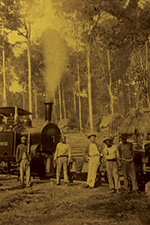
Collection image: Construction of British Guiana Railway through Sandbach Tinne and Co. plantations, Enterprise and Providence, c 1890 (photographer unknown, held by National Museums Liverpool, Archives Centre, reference D/B/176B/34).
If you are a rights holder and are concerned that you have found material on our site for which you have not given permission or is not covered by an exception or exemption in national law, please contact us .